

Flip the furnace on for the first time this fall and catch a whiff of something off? If your furnace smells like gas, that’s not a smell to shrug off and hope it goes away. Some odors during a first fall start-up are completely normal; others mean you need to act fast. In this guide, you’ll learn how to tell the difference between a harmless burning-dust smell and an actual gas leak, what steps to take immediately if you suspect the real thing, and how homeowners and businesses across the southwest Chicago suburbs can prevent this from happening in the first place.
Why This Matters
Natural gas itself is odorless — utility companies add a chemical called mercaptan, which smells like rotten eggs or sulfur, specifically so leaks are detectable by smell. That means if your furnace smells like gas in that sulfur, rotten-egg way, it’s not a false alarm to investigate later; it’s a signal designed to get your attention immediately. On the other hand, a mild, dusty, slightly burnt smell during the very first heating cycle of the season is common and usually harmless, since it’s just dust burning off equipment that’s been unused all summer. Confusing the two — or ignoring either one — is the most common and costly mistake homeowners make every fall.
This matters just as much for businesses as it does for houses. A campus like Lewis University in Romeoville runs heating systems across dozens of buildings, and a gas safety issue in even one building isn’t something that can wait for a convenient time. The same goes for a gathering spot like Werk Force Brewing Co. in Plainfield, where reliable, safe heating keeps a tasting room comfortable through the colder months, and for a clubhouse like Bolingbrook Golf Club, home to The Nest Bar & Grill, where guests are on-site for hours at a time. Homeowners and business owners throughout Lemont, Homer Glen, Lockport, Romeoville, Bolingbrook, Orland Park, Mokena, Plainfield, Naperville, and Woodridge all rely on the same basic safety instinct: when in doubt, don’t wait it out.
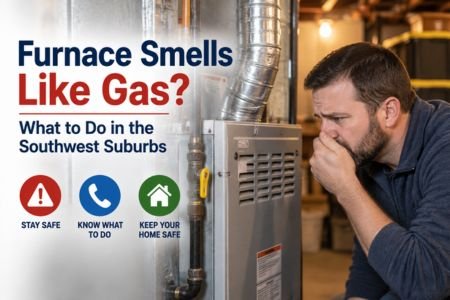
Furnace Smells Like Gas — What Homeowners Need to Know
Common Signs and Warning Signals
Here’s how to tell what kind of smell you’re dealing with:
- Normal: A faint, dusty, slightly burnt smell during the very first heating cycle of the season, which fades within 30–60 minutes
- Not normal: A rotten-egg or sulfur smell that lingers or gets stronger, especially near the furnace, gas meter, or basement floor
- Not normal: A hissing sound near a gas line or connection, with or without an odor
- Not normal: The smell is accompanied by physical symptoms like headache, dizziness, or nausea
- Not normal: The smell returns repeatedly across multiple heating cycles, not just the first one of the season
Common Causes
A genuine gas smell almost always traces back to one of a few sources: a loose or deteriorated gas line connection, a cracked heat exchanger allowing combustion gases to escape where they shouldn’t, a pilot light or ignitor malfunction that’s disrupting normal combustion, or, less commonly, a damaged gas meter or supply line outside the home. A harmless start-up smell, by contrast, is almost always just accumulated dust on the burners and heat exchanger, burning off during the season’s first cycle — a one-time event, not a recurring one.
DIY vs. Professional Service
If you smell anything resembling rotten eggs or sulfur, this is not a DIY situation. Leave the house immediately, avoid using light switches, phones, or anything that could create a spark, and call your gas utility’s emergency line or 911 from outside or a neighbor’s home. Once it’s confirmed safe, a licensed HVAC technician needs to locate and repair the source before the system runs again. For the normal burning-dust smell, no action is required beyond making sure it clears within the first hour and doesn’t return on the next heating cycle.
Prevention and Maintenance Tips
A few habits reduce the odds of this happening at all:
- Schedule an annual furnace tune-up every fall, before you rely on the system for winter
- Replace filters regularly so dust doesn’t accumulate as heavily near the burners
- Install a carbon monoxide detector near sleeping areas if you don’t already have one
- Have gas line connections inspected any time you notice a change in smell, sound, or furnace performance
- Never ignore a repeat gas smell, even if it seems to resolve on its own
Professional Recommendations
The best practice for every home and business in our service area is simple: treat the first fall start-up as a test run, not a set-it-and-forget-it moment. Run the furnace on a mild day before you actually need it, stay near the house for the first cycle, and pay attention to what you smell and hear. If anything beyond a brief, mild dust smell shows up, that’s your cue to call a professional rather than waiting to see if it resolves.
Cost-saving tip: a fall tune-up that includes a gas line and heat exchanger inspection catches most of the issues that would otherwise show up as a scary smell mid-winter — it’s far cheaper and far less stressful to address in September. If you ever have doubt about which type of smell you’re dealing with, treat it as the serious version and call for service; there’s no downside to being cautious with gas safety.
Most-Asked Questions About Furnace Smells Like Gas
Is it normal for my furnace to smell like gas when I turn it on for the first time? A mild, dusty smell that clears within an hour is normal. A rotten-egg or sulfur smell, especially if it lingers or gets stronger, is not normal and should be treated as a possible gas leak.
What should I do if I smell gas near my furnace? Leave the home immediately, avoid creating any spark (no light switches, phones, or appliances), and call your gas utility’s emergency line or 911 from a safe location outside.
U.S. Consumer Product Safety Commission — Natural Gas and Carbon Monoxide Safety
Why does gas have a smell if natural gas is odorless? Utility companies add a chemical called mercaptan specifically so leaks are detectable by smell before they become dangerous — it’s a built-in safety feature, not an accident.
Can a furnace tune-up prevent gas smell issues? Yes, in most cases. A tune-up inspects gas line connections, the heat exchanger, and the ignition system — the same components responsible for most gas-related odors when something is wrong.
Why Choose Salmark HVAC
We serve homeowners and businesses throughout Lemont, Homer Glen, Lockport, Romeoville, Bolingbrook, Orland Park, Mokena, Plainfield, Naperville, Woodridge, and the surrounding communities, and gas safety is something we take seriously on every single call. Whether it’s a single furnace or a multi-building property like Lewis University in Romeoville, we approach every inspection the same way — thorough, honest, and focused on catching problems before they become dangerous.
What sets us apart:
- Honest recommendations — we’ll walk you through exactly what we find and why it matters
- Emergency HVAC service when a gas smell or safety issue can’t wait
- Upfront pricing with no pressure to upsell
- Residential and commercial expertise across furnaces, gas piping, rooftop units, and water heaters
- Fast scheduling for fall tune-ups before the season’s first cold night
When it comes to gas safety, a quick call is always the right call.
Ready to Get Your Furnace Inspected Before Winter?
If your furnace has smelled off, or you just want peace of mind before you rely on it all winter, don’t wait to find out the hard way. Reach out today for a free estimate, and let’s make sure your system is safe and ready.